Please be aware of our copyright notice. If you have a good reaon for using a photo from this site ask permission from first - it is frequently given.
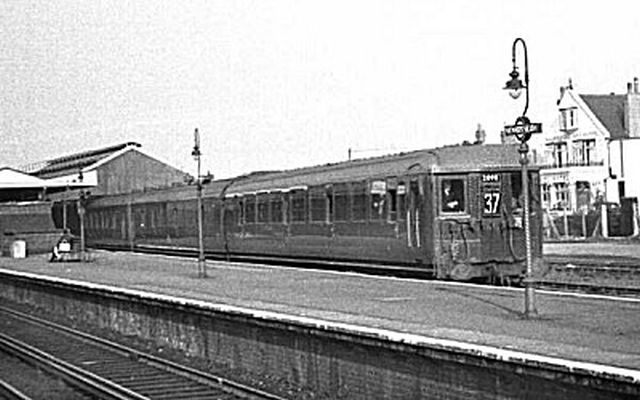
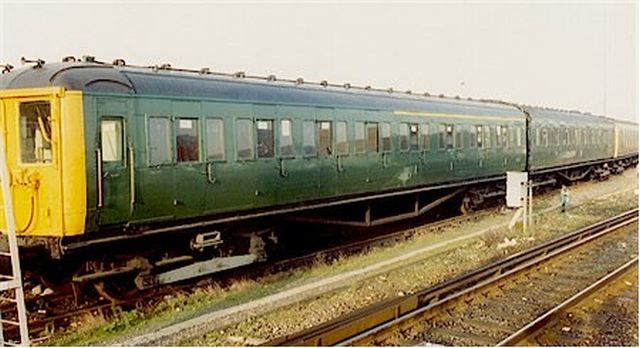
2-Bil

|
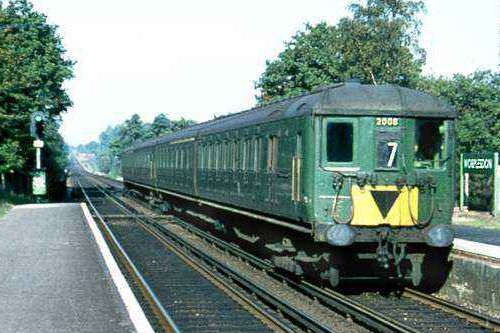
photograph by Keith Harwood
|
| The 2 Bil (bi-lavatory) first appeared as a batch of 10
semi fast main line units to a contemporary design during 1935 for use on the
Eastbourne line. Each unit consisted of a motor brake third and a driving
trailer composite. In the motor car behind the driver's cab was a full
width luggage/guard's van followed by seven third (later, under BR, second)
class compartments off a side corridor and at the inner end a toilet
compartment. In the driving trailer were four first and four third class
compartments connected by a side corridor, a toilet at the inner end and the
Guard's/luggage compartment the floor of which was partly raised to
accommodate the electo-magnetic control gear. The bodies were steel panelling
on a hardwood wooden frame on a steel undeframe.
A further batch of Bils was introduced in 1936 for use on the Waterloo to Portsmouth (slow) and Waterloo to Alton services. The final batch in 1938 was built for use on the Waterloo to Reading line. These two later batches had a different internal layout to the motor car with larger luggage area, six first class compartments and one four seat coupe. These units had flat floors to the Guard's/luggage compartment as they were fitted with under-floor-mounted electro-pneumatic control gear. Following an accident where a steam train had run into the back of a 2 Bil standing at Woking, it was decided to bring the end load strength for future construction up from 90 tons to 120 tons and all new 62ft underframes were fitted, increasing the weight of both the motor brake thirds and the driving trailers by one ton. |
|





This page was last updated 15 May 2010